To interpret,
or not to interpret.
That is the question.
“When contemplating a work of art, our brain simulates states that
are linked to the object of art and the artist; such an empathetic link and mental imagery might be at the heart of our aesthetic judgment” (Levent and Pascual-Leone, 2014, p.xxiii).
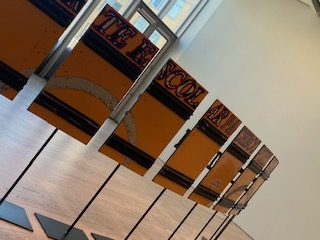
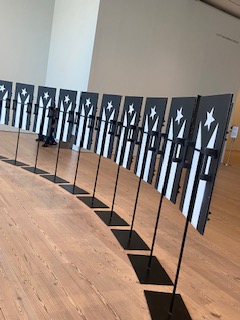
Day one starts off with various conversations for attention, but by the end of the day, two main points stuck in my head preparing to wage war for the future of Puerto Rico and battling to create a “perfect” visitor’s experience versus allowing the interpretation of the curators working with the museum. When allowed to explore the Whitney Museum an art piece that stands out was the Miguel Luciano piece Shields/Escudos, 2020. This piece captured my attention as I approached the exhibit, it was clear that this was a line of bus pieces/panels and could be seen from across the room in its bright yellow. However, it was not until I reentered from the outside exhibits that the handles and police/military-like shields, and black and white Puerto Rican Flag design could be fully taken in. The stark difference of a brighter childhood-like memory of a bus with the harsh and cold protective and warlike feel of the back side for me created a “mental imagery,” that connected me as a visitor and my past memories and feelings and then allowed me to see it as art.
The struggle between education and protection was what stuck out and for me created the idea of education versus the military/government in charge. Where the final thoughts on the conflict are going will be struggling for days, but upon reading the exhibit panel it was clear that Luciano worked and struggled with this conflicting aspect too. It was also interesting that with the struggle in Puerto Rican children’s education, The Whitney elected to add an educational, interpretation to include children in the its educational booklet/Activity Guide for Kids that connected Puerto Rican Art in the Wake of Hurricane Maria. However, this educational experience for younger visitors seemed to stop at the Activity Guide and did not appear on the museum walls; children did not seem to be a consideration at all. This conflicting idea of who is our focused visitor and where the future lies may be found past the interpretation. By the end of the day, it reminded me that we may need a guide but who gets to be the guide the museum or the visitor?
References: Levent, N. and Pascual-Leone, A., Eds. (2014). Introduction. The Multisensory Museum: Cross-Disciplinary Perspectives on Touch, Sound, Smell, Memory, and Space. Rowman & Littlefield.
 Swancey's Travels
Leave a comment