Blog 2-Tribute to childhood memories.
Memories of Colonial Williamsburg from a stroller until present time.
Given some time to reflect on the memorable experiences that were shared a common thread felt like we all had a passion that was fulfilled by visiting a museum at an early age. My first memorable moment was a reflection on a childhood experience in Colonial Williamsburg, Virginia. The early memory was of me as a little child strolling and running down Duke of Glouster Street. I was running ahead of my family to find colonial interpreters (fancy-dressed people as I called them) and which buildings had the flags out; which meant we could go inside and meet more “historical” people.
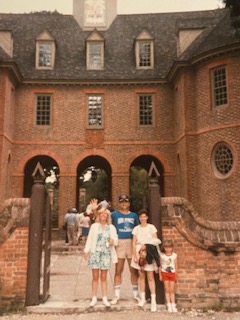
(I have attached a picture of myself, my mother, and family friends Kenny and Julia. We are all standing outside the Capital building in Colonial Williamsburg).
As a child. I thought these were the people’s actual homes and they lived there in the town of Williamsburg. I believed the people dressed like that all of the time, made their food over an open fire, and lived like this 365 days of the year. I didn’t share this during the meeting, but seeing a colonial-inspired ball in Colonial Williamsburg, at probably the age of 7 or 8 furthered my desire to be a part of this unknown world. (Attached is an image of the ball. I discovered this while looking for my childhood memories).
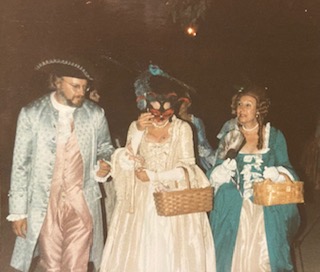
My parents always knew Colonial Williamsburg wasn’t a “real” place and at about 9 or 10 years old is when I told my parents about Santa, and Easter Bunny, and this 365 days a-year colonial life not being real/true. But Colonial Williamsburg is the truth because it existed and it is a recreated living history that is researched and expands visitor’s belief because it establishes a history of trust. As Marks writes, “By more effectively and carefully articulating the nature of historical work, historians and museum professionals can get on the same page with our audiences and foster trust built on mutual understanding” (2022). My parents trusted Colonial Williamsburg as a place for me to learn, engage, and be safe walking around or running ahead of them. Therefore I trusted my parents and this allows me to build my own trust in the work of Colonial Williamsburg. When I learned HOW Williamsburg knew of this historical information through research and interacting with the interpreters it built my trust in that real city. This belief and trust are why when traveling to a new city I always desire to see a museum because if the city doesn’t have a museum I do not want to go. This feeling was echoed in John Falk’s idea of, “popular leisure venues that most find highly satisfying, we can conclude that museum experiences must somehow be supportive of people’s well-being,” and probably why my Disney loving friends do not get my fascination with historical places.
So bring it on, New York City. With ALL of your museums. I am ready to support my well-being as a person and a learner.
References
Hawkins, B. (2022, February 14). 5 Ways to Make Your Historic House Museum Visitors Feel at Home (Even with Uncomfortable Topics). Retrieved March 6, 2023, from https://aaslh.org/5-ways-house-museum/
Marks, J. G. (2022, February 7). History Museums and Trust. Retrieved March 6, 2023, from https://aaslh.org/history-museums-and-trust/
 Swancey's Travels
Leave a comment